

 All articles
The trick professionals use to walk a kid through something new — before it happens.
A short, calm, accurate description of a thing that's about to happen. Read enough times that the thing stops being unknown.
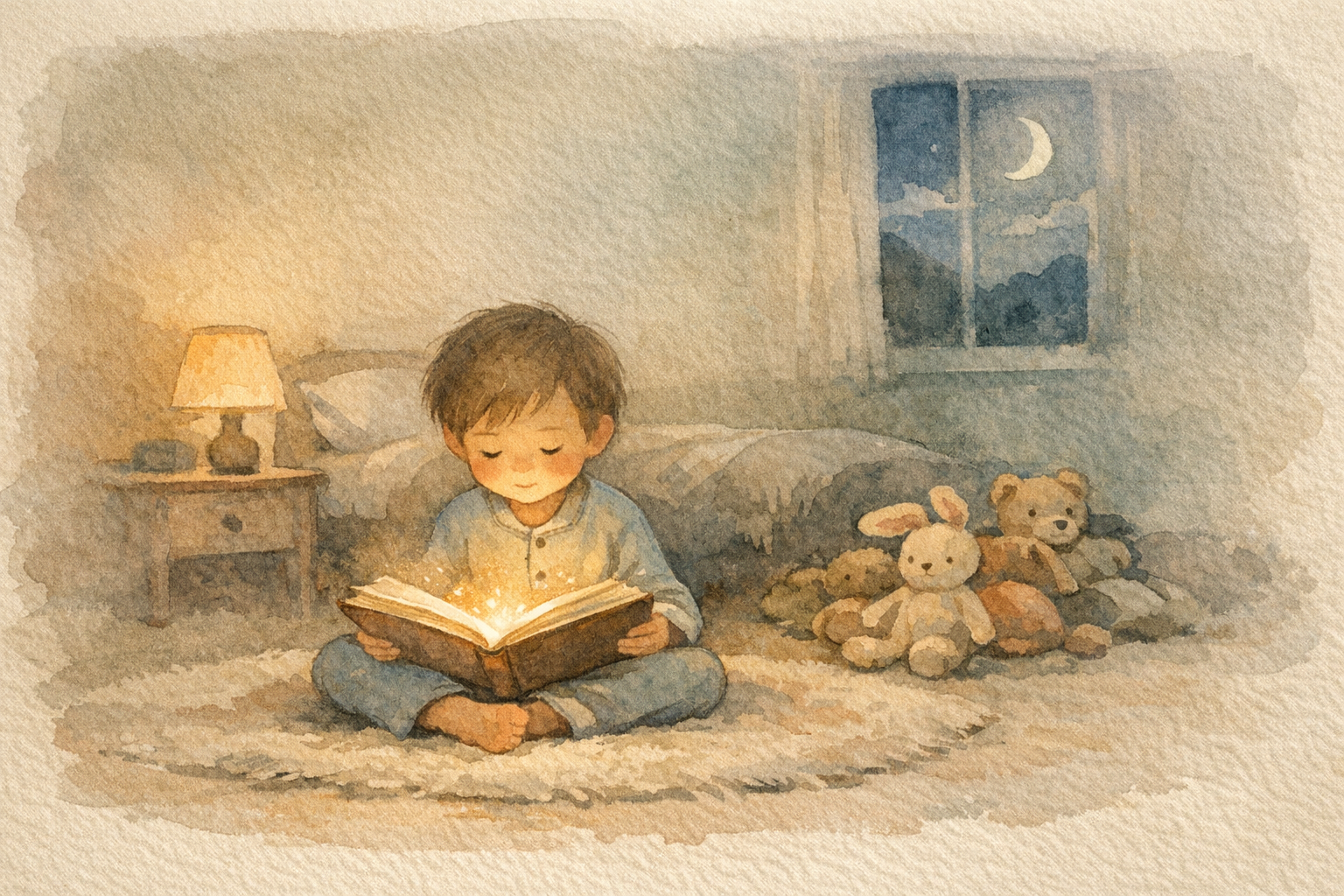

The night before kindergarten — really the whole week before — a kid does not know what they are walking into. Not in a vague, "new things are scary" way. In a specific way. They don't know which door to go in. They don't know if their teacher is going to be loud or quiet. They don't know what happens if they need the bathroom in the middle of a song. They don't know whether snack is before or after the playground, whether the bus stops at their corner or the next one, whether the kid in the red shirt who keeps looking at them is going to be a friend or a problem. The unknown is doing most of the work, and it's a lot of work.
There is a small, plain technique for this. It was not invented for kindergarten. It was invented in 1990, in a public school in Jenison, Michigan, by a teacher named Carol Gray, for autistic students who were missing the unspoken information. It's called a Social Story, and over the last thirty-some years it has quietly become one of the most-used preparation tools in special education, speech-language therapy, and — increasingly — ordinary parenting.
What it is, mostly, is a short, calm, accurate description of a thing that's about to happen. Read enough times that the thing stops being unknown.
Where it came from
Gray was the first teacher for autistic students at Jenison Public Schools, a job she held from 1977 to 2004. In 1989 and 1990, she had two students who changed how she taught. The first was Eric, a high school student who kept interrupting an assembly speaker. After watching a video of himself doing it, Eric understood for the first time what "stop interrupting" actually meant in practice. Gray later wrote that "placing the same information in writing made a critical difference. Eric understood and applied what he read."
The second was a kindergartner named Tim, who was struggling in PE class with a game called "Charlie Over the Water." Gray wrote him a short story about it. Tim read it daily. The next time the game was announced, he raised his hand and asked to be Charlie. He played it calmly and competently — which had not, until then, been an option.
The pattern Gray noticed in the stories that worked was that they shared, in her phrase, "a patient and positive tone." That phrase has stuck. Three decades later, the formal criteria for a Social Story still require, as the first thing on the list, "an overall patient and supportive quality."
What it actually is
A Social Story is not a parable. It does not have a moral. It does not warn the kid about anything. It is closer to a documentary, narrated kindly, in language the kid already understands, about a thing they're about to live through.
Gray formalized the method into ten defining criteria — the current version, Social Stories 10.4, was released in 2023 and reorganized the criteria into four areas with a stronger focus on what Gray calls Social Humility, plus explicit guidance on when a Story may not be the best option. The heart of the method, though, is still the kind of sentence you're allowed to use. Practitioners working from her framework typically lean on four:
Try it
The four sentence types, with one example each.
Tap a type. The example below changes. The whole technique fits in here somewhere.
Practitioners typically write one coaching sentence for every two to five descriptive or perspective sentences. The point isn't to lecture the kid — it's to describe the world accurately enough that what to do becomes obvious.
The other quietly important rule: the story is written in the first person, from the kid's point of view. Not "you will go to school." "I will go to school." The kid is reading themselves into a future they haven't lived yet. That's the whole technique, in one grammatical choice.
Why it works (and what we can honestly say about that)
The straightforward mechanism is the same one that makes a job interview easier the second time, or a new commute easier on day three. It's preparation. Familiarity. What clinicians call mental rehearsal — walking through an event in your head, ahead of time, in a relaxed state, until it stops being a wall of unknowns and becomes something you've sort of already done.
The research on anticipatory anxiety in children is reasonably consistent on this point: kids who are given the chance to mentally rehearse an upcoming event do better when the event arrives. Pediatric medical preparation programs — which clear a much harder evidence bar than back-to-school jitters — use exactly the things a Social Story does: narrative information about what's going to happen, a tour of the space (in pictures, if not in person), and modeling what coping looks like. The general principle is the same one clinicians give parents around any anticipated transition: talk about it in advance, not at the door.
Now, the harder question — does the specific intervention called a Social Story actually work, in a way you can isolate from everything else going on — is more interesting than the marketing version of this technique would suggest.
Social Stories are formally classified as an evidence-based practice for autistic learners ages roughly 3 to 18 by the National Clearinghouse on Autism Evidence and Practice, based on around 21 single-case and group-design studies. That's a real designation; it doesn't get handed out casually. But the Association for Science in Autism Treatment, which is unusually careful about this stuff, flags that "there is mixed evidence on the effectiveness of Social Stories" and notes that many studies bundled them with other techniques like prompting, making it hard to say what the story itself did.
The largest randomized controlled trial to date, ASSSIST-2, ran across 87 UK primary schools and 249 autistic children aged 4 to 11. Its 2025 results were a useful kind of mixed: on the broad measure of social responsiveness, the effect was small and not statistically significant. But on the specific socio-emotional goal each child had been given a Social Story to address, kids who got the story were significantly more likely to meet that goal — at six weeks and again at six months — than kids who got usual care alone.
That distinction matters. Social Stories are not a personality upgrade. They appear to do one specific job — helping a kid get through a specific situation — reasonably well. They are not a substitute for therapy, and the research outside of autism populations is thinner and more recent. A 2024 meta-analysis of 21 studies covering 921 children, including non-autistic preschoolers, found Social Story interventions were significantly more effective than conventional instruction at teaching specific behaviors (the example studied most often was, of all things, toothbrushing). But the authors were the first to note that most of the studies had small sample sizes, and they called for "more well-designed randomized controlled trials" before drawing wider conclusions.
So: the method exists, it has formal criteria, it has been studied for thirty years, and used well it appears to do what it claims to do for the specific moment it's pointed at. It is not magic. It is more like a well-shaped tool, sitting on a shelf, that more parents could be reaching for than do.
How a parent actually uses one
The mechanics are unglamorous, which is part of why it works.
- Pick one specific moment. Not "school" — "the first morning of kindergarten, from the car to the classroom." Not "the dentist" — "the cleaning, where they use the spinny brush." The narrower the better. A Social Story is a documentary, not a survey course.
- Write it short, in their voice. First person. Present or near-future tense. Mostly descriptive. A coaching sentence here and there. End on something true and reassuring — usually a parent or a known adult coming back at the end of the day.
- Read it more times than feels necessary. Once a night for a week or two. Right before the event. Repetition is not a bug. It's the active ingredient. The clinical recommendation is to fold it into a routine — bedtime, after dinner — so the kid encounters the new situation often enough that it stops being new.
- Use it after, too. Stories aren't only anticipatory. If something happened at school the kid didn't understand — a fire drill, a substitute, a kid who cried and they don't know why — a short story written after the fact can do the same work in reverse. It gives a confusing event a shape.
One last thing. The book — or the audio, or whatever form it takes — is the smaller half of what's going on. The bigger half is the parent reading it, in the kid's voice, calmly, every night, until it stops being a story and starts being a thing they already know. It is a small, nightly practice that says: I have thought about this. I will be there. Here is exactly how it goes.
The point
There's a reason this technique survived thirty years of education-fad churn while a thousand glossier ones didn't. It respects the kid. It treats them as someone capable of handling real information about their real life, given a few quiet evenings to absorb it. It doesn't try to talk them out of being nervous. It just hands them a map.
For the very specific case of starting kindergarten, that map can be: the route to the classroom, the teacher's name, the song they sing in the morning, where lunch happens, what the bus looks like, who's coming to get them. Read every night for a couple of weeks. By the first day, the place isn't new anymore. They've already been there, in their head, fifteen times.
Try one yourself
Three answers, and we'll start a story.
The actual writing-and-illustrating part happens after you sign up — but you can shape the brief here. Whatever you put in lives in your account when you arrive on the other side.
Personalized social story, illustrated and narrated. Yours to read all summer.
Sources
Where this came from.
-
1
Carol Gray — The Discovery of Social Stories
The originator's account of how the method emerged in 1989-90 — Eric watching the assembly video, Tim and 'Charlie Over the Water'.
-
2
Carol Gray — What is a Social Story?
The current Social Stories 10.2 criteria, including the "patient and supportive quality" requirement.
-
3
Indiana Resource Center for Autism — Writing and Using Social Narratives
The four sentence types (descriptive, perspective, coaching, affirmative) and the recommended ratio.
-
4
Association for Science in Autism Treatment — Social Stories
Honest assessment of the mixed evidence base and ASAT's guidance to use Social Stories alongside, not instead of, stronger interventions.
-
5
ASSSIST-2 RCT (Wright et al., 2025)
The largest randomized controlled trial to date — 87 schools, 249 autistic children, mixed results that were strongest on targeted goals.
-
6
Social Story Intervention for Preschool Children — meta-analysis (2024)
21 studies, 921 children. Significant effects on specific behaviors; authors call for larger RCTs.
-
7
Parent Trust for Washington Children — Mental Rehearsal
How walking through an upcoming event in your head reduces anticipatory stress.
-
8
Hand Spring Health — Anticipatory Anxiety in Children
Practitioner guidance on talking through transitions in advance.
-
9
NAEYC — Easing First-Day Jitters
Recommendations for predictable routines and role-playing transitions before they happen.
A note on how this was researched
This article was researched against ten primary sources, including Carol Gray's foundational work, the largest randomized trial to date (ASSSIST-2, 2025), and recent meta-analyses. Every claim was checked against a fetched source. We also kept a paper trail of what we considered but couldn't verify — published openly, because trust comes from showing your work.
Read the full research notes